Debt Consolidation vs. Snowball: 2026 Strategy to Cut Debt 20%
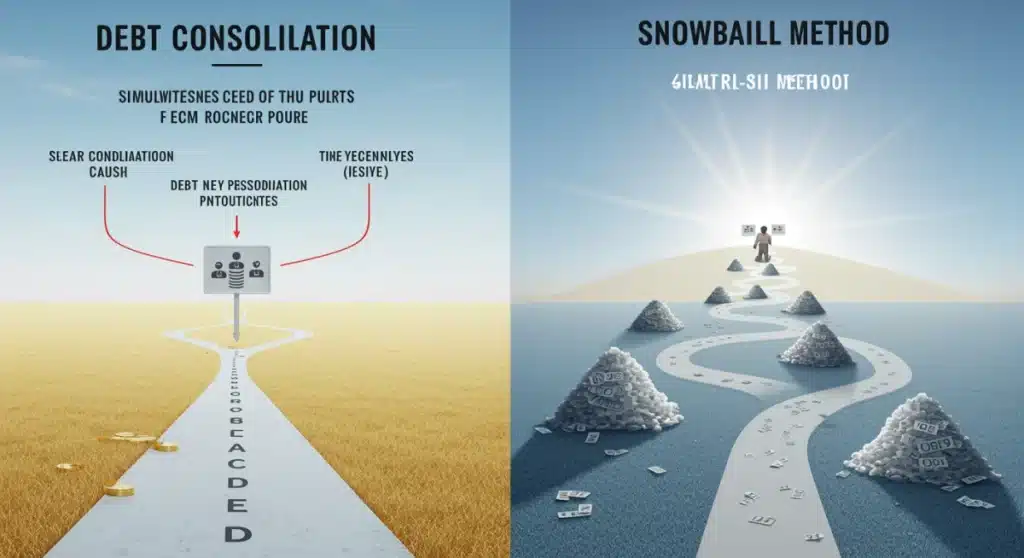
Comparing debt consolidation and the snowball method reveals distinct approaches to consumer debt reduction, with each strategy offering unique benefits and drawbacks for individuals aiming to cut their debt by 20% in 2026.
Are you looking to significantly reduce your consumer debt by 20% in 2026? Navigating the world of personal finance can be daunting, especially when faced with multiple debts. Two prominent strategies often emerge in discussions about debt elimination: debt consolidation snowball method. This article will delve into a comprehensive comparison, helping you understand which approach might be best suited for your financial journey.
Understanding debt consolidation: a unified approach to debt
Debt consolidation involves combining multiple debts, typically high-interest ones, into a single, new loan with a lower interest rate or a more manageable monthly payment. This strategy aims to simplify the repayment process and potentially reduce the total interest paid over time. The core idea is to replace several payments with one, making financial management less complex.
For many, the appeal of debt consolidation lies in its potential to streamline finances. Instead of tracking multiple due dates and varying interest rates, you have a single payment to remember. This can alleviate stress and help individuals regain a sense of control over their financial obligations. However, it’s crucial to understand the different forms debt consolidation can take.
types of debt consolidation loans
There are several avenues for debt consolidation, each with its own set of advantages and considerations. Choosing the right type depends on your creditworthiness, the amount of debt, and your financial goals.
- Personal loans: These are unsecured loans from banks or credit unions, often with fixed interest rates and repayment terms. They are popular for consolidating credit card debt.
- Balance transfer credit cards: This involves moving high-interest credit card balances to a new card offering a 0% introductory APR for a promotional period. Careful planning is essential to pay off the balance before the regular APR kicks in.
- Home equity loans or lines of credit (HELOC): If you own a home, you can borrow against its equity. These typically offer lower interest rates but put your home at risk if you default.
The success of debt consolidation heavily relies on securing a lower interest rate than the average of your existing debts. Without a significant reduction in interest, the benefits might be minimal, or the repayment period could even be extended, leading to more interest paid overall.
In conclusion, debt consolidation offers a clear path to simplifying debt repayment by combining multiple obligations into one. While it can reduce interest and organize payments, the specific type of consolidation and the interest rate secured are critical factors in determining its effectiveness for achieving a 20% debt reduction goal.
Exploring the debt snowball method: momentum for motivation
The debt snowball method is a debt reduction strategy where you pay off debts in order of smallest balance first, regardless of the interest rate. Once the smallest debt is paid off, you take the money you were paying on that debt and add it to the payment of the next smallest debt. This creates a ‘snowball’ effect, building momentum as you eliminate each debt.
This method primarily targets psychological motivation rather than purely mathematical efficiency. The quick wins of paying off smaller debts provide a sense of accomplishment and encourage individuals to stick with their debt repayment plan. This emotional boost can be powerful, especially for those who feel overwhelmed by their total debt burden.
how the snowball method works in practice
Implementing the debt snowball method involves a few straightforward steps. Consistency and discipline are key to seeing results and building that all-important momentum.
- List all debts: Compile a comprehensive list of all your debts, from credit cards to personal loans, excluding your mortgage.
- Order by smallest balance: Arrange these debts from the smallest outstanding balance to the largest.
- Minimum payments on all but the smallest: Make minimum payments on all debts except for the one with the smallest balance.
- Attack the smallest debt: Pay as much as you possibly can towards the smallest debt until it is completely paid off.
Once the smallest debt is gone, you celebrate that victory. Then, you take the payment amount you were contributing to that smallest debt and add it to the minimum payment of the next smallest debt. This increased payment allows you to pay off the next debt faster, rolling the momentum forward. This process continues until all debts are eliminated.
The debt snowball method prioritizes psychological wins over interest savings, making it highly effective for individuals who need consistent motivation to stay on track. Its simplicity and focus on quick successes can be a powerful tool for achieving significant debt reduction, such as a 20% target.
Key differences: consolidation vs. snowball in 2026
When comparing debt consolidation and the debt snowball method for 2026, it’s essential to understand their fundamental differences in strategy, focus, and potential outcomes. Both aim to reduce debt, but their pathways to that goal diverge significantly, appealing to different financial personalities and situations.
Debt consolidation is primarily a mathematical strategy. It focuses on reducing the interest paid and simplifying payments by combining debts. The goal is to save money on interest over the long term and make the repayment process more manageable. This approach often requires a good credit score to secure favorable interest rates.
strategic and psychological contrasts
The core distinction lies in their primary drivers: one is financial efficiency, the other is behavioral motivation. Understanding this can help you decide which method aligns better with your personal approach to money management.
- Mathematical efficiency vs. psychological motivation: Consolidation aims for the lowest overall cost; snowball prioritizes quick wins for encouragement.
- Credit score requirement: Consolidation often requires a good credit score to qualify for better rates; snowball does not depend on your credit score to begin.
- Payment structure: Consolidation results in one payment; snowball maintains multiple minimum payments plus one aggressive payment.
The debt snowball, conversely, is a behavioral strategy. It leverages human psychology by providing frequent small victories, which can be incredibly motivating. By tackling the smallest debts first, individuals experience a sense of progress and achievement, making them more likely to stick with the plan, even if it means paying slightly more in interest over time. It doesn’t require an excellent credit score to start, making it accessible to a wider range of individuals.
In summary, the choice between debt consolidation and the debt snowball method boils down to whether you prioritize mathematical savings through lower interest rates or psychological motivation through quick wins. Each method offers a viable route to debt reduction in 2026, but their effectiveness depends on your personal financial discipline and preferences.
Advantages and disadvantages of debt consolidation
Debt consolidation, while offering a clear path to simplified debt management, comes with its own set of pros and cons. Understanding these can help you determine if it’s the right strategy for your 2026 debt reduction goals.
One of the most significant advantages is the potential for lower interest rates. If you can secure a consolidation loan with a rate significantly lower than your existing debts, you could save a substantial amount on interest over the life of the loan. This means more of your payment goes towards the principal, accelerating your debt-free journey.
the pros and cons to consider
Weighing these points carefully is crucial before committing to a debt consolidation strategy. The decision should align with your financial habits and long-term objectives.
- Advantages:
- Simplified payments with a single monthly bill.
- Potentially lower overall interest rates, saving money.
- Fixed repayment terms, offering predictability.
- Reduced stress from juggling multiple creditors.
- Disadvantages:
- Requires a good credit score for favorable terms.
- If a home equity loan is used, your home is collateral.
- Risk of accumulating new debt if spending habits don’t change.
- Fees associated with new loans or balance transfers.
Another benefit is the psychological relief of having a single, manageable payment. This simplification can reduce the mental burden of debt, freeing up cognitive resources that were previously spent worrying about multiple due dates and creditors. However, a major drawback is the risk of falling back into debt. If underlying spending habits aren’t addressed, consolidating debt can simply create more available credit, leading to a cycle of new borrowing.
Ultimately, debt consolidation is a powerful tool for those with good credit who are disciplined enough to avoid new debt. It offers financial efficiency and simplicity, which can be highly effective in achieving a 20% debt reduction if managed responsibly.
Advantages and disadvantages of the debt snowball method
The debt snowball method, while less focused on interest rate optimization than consolidation, offers distinct advantages, particularly in terms of behavioral economics. However, it also has its own set of drawbacks that individuals should consider.
The primary advantage of the debt snowball is its powerful psychological impact. Paying off smaller debts quickly provides tangible wins, which can be incredibly motivating. This momentum helps individuals stay committed to their debt repayment plan, even when facing a significant overall debt burden. It fosters a sense of progress and control, which can be crucial for long-term adherence.
balancing motivation with cost
Understanding where the debt snowball shines and where it might fall short is key to deciding if it’s the right strategy for your debt reduction journey in 2026.
- Advantages:
- Strong psychological motivation from quick wins.
- Simplicity and ease of understanding.
- No credit score requirement to begin.
- Builds discipline and financial habits over time.
- Disadvantages:
- Potentially higher total interest paid compared to the debt avalanche (highest interest first).
- May take longer to become debt-free if high-interest debts are large.
- Requires consistent discipline to maintain momentum.
A significant disadvantage of the debt snowball method is that it might lead to paying more in total interest. By prioritizing smaller balances over higher interest rates, you could be incurring more interest charges on those larger, higher-rate debts for a longer period. This makes it less mathematically efficient than the debt avalanche method, which prioritizes debts by interest rate.
In conclusion, the debt snowball method is an excellent choice for those who need a strong psychological boost to tackle their debt. While it might cost slightly more in interest, the motivational benefits can outweigh the financial differences for many, making it a viable and effective strategy for achieving a 20% debt reduction goal.
Choosing the best strategy for your 2026 debt reduction goals
Deciding between debt consolidation and the debt snowball method for your 2026 debt reduction goals is a personal choice that depends on several factors: your financial situation, credit score, debt amount, and most importantly, your personality and motivation style. There isn’t a one-size-fits-all answer, but by evaluating your specific circumstances, you can make an informed decision.
If you have a strong credit score and a disciplined approach to managing money, debt consolidation might be the more financially efficient option. It allows you to potentially secure a lower interest rate, which translates to less money spent on interest over time and a faster path to becoming debt-free. The simplification of payments can also be a significant benefit, reducing the mental load of debt management.
factors influencing your decision
Consider these points carefully to align your chosen strategy with your financial personality and objectives. Your ability to stick with the plan is paramount.
- Credit score: High scores favor consolidation; low scores make snowball more accessible.
- Debt amount and types: Many small debts might suit snowball; several large, high-interest debts could benefit from consolidation.
- Motivation style: If quick wins motivate you, choose snowball; if financial efficiency is key, consider consolidation.
- Risk tolerance: Consolidation with collateral (like home equity) carries more risk.
On the other hand, if you find yourself easily discouraged, or if you need consistent victories to stay motivated, the debt snowball method could be your ideal choice. The immediate gratification of paying off smaller debts can ignite a powerful sense of accomplishment, propelling you forward even if it means sacrificing some interest savings. This method is particularly effective for those who feel overwhelmed by the sheer number of their debts.
Ultimately, the best strategy is the one you can stick with consistently. Whether you opt for the mathematical efficiency of debt consolidation or the motivational power of the debt snowball, the goal remains the same: reducing your consumer debt by 20% in 2026. Evaluate your situation honestly, and choose the path that empowers you most effectively.
| Strategy | Brief Description |
|---|---|
| Debt Consolidation | Combines multiple debts into one loan, often with a lower interest rate, simplifying payments. |
| Debt Snowball Method | Pays off debts from smallest to largest balance, building psychological momentum. |
| Primary Focus | Consolidation: mathematical efficiency; Snowball: psychological motivation. |
| Ideal Candidate | Consolidation: good credit, disciplined; Snowball: needs motivation, quick wins. |
Frequently asked questions about debt reduction
The primary benefit of debt consolidation is simplifying multiple debt payments into a single, often lower, monthly payment. This can also lead to a reduced overall interest rate, saving you money in the long run and making your debt more manageable. It streamlines your finances significantly.
The debt snowball method boosts motivation by allowing you to quickly pay off smaller debts first. These early successes provide psychological wins and a sense of accomplishment, encouraging you to stick with the plan and continue tackling larger debts with increased enthusiasm and discipline.
While typically seen as alternatives, you could potentially combine aspects. For example, consolidate some high-interest, large debts, then use the snowball method for any remaining smaller debts or new debt accumulated. However, it’s generally best to focus on one strategy for clarity and effectiveness.
Debt consolidation, when it secures a significantly lower interest rate, is generally more mathematically efficient. It directly reduces the total interest paid over the life of the loan. The debt snowball method, while motivating, might result in paying more interest by prioritizing smaller balances over higher rates.
Risks include needing good credit to qualify for favorable terms, potentially extending the repayment period, and the danger of accumulating new debt if spending habits aren’t addressed. If you use a home equity loan, your home could be at risk if you default on payments.
Conclusion
Achieving a 20% reduction in consumer debt by 2026 is an ambitious yet attainable goal, and the choice between debt consolidation and the debt snowball method is a critical step in that journey. Both strategies offer distinct paths to financial freedom, catering to different financial behaviors and priorities. Debt consolidation appeals to those who prioritize mathematical efficiency and simplification, leveraging lower interest rates and a single payment structure. Conversely, the debt snowball method is ideal for individuals who thrive on psychological wins and need consistent motivation to stay committed to their debt repayment plan. Your credit score, the types of debt you carry, and your personal discipline will ultimately guide you to the most effective strategy. Regardless of the path chosen, consistency, a clear understanding of your financial situation, and a commitment to healthy spending habits are paramount for success. By carefully evaluating these factors, you can confidently embark on your journey to significant debt reduction and a more secure financial future.